704-844-2943
AVAILABLE FOR EMERGENCIESCan Emergency Dental Care Prevent Long-Term Tooth Damage?

Dental emergencies don’t announce themselves. A tooth cracks while you’re eating dinner, a filling falls out on an afternoon mid-week, or you wake up to a jaw that’s swollen in a way that wasn’t there yesterday. These moments are disorienting, often painful, and easy to talk yourself out of treating immediately. But that delay is exactly where long-term damage begins.
The short answer to the question in this blog’s title is yes. Getting prompt dental care after an emergency genuinely does change the outcome. Not just in terms of comfort, but in how much of your natural tooth structure you keep, how much treatment you eventually need, and how your surrounding teeth and gums hold up over time. This blog explains why, and what you should know before the next emergency catches you off guard.
Why Timing Is Everything in a Dental Emergency
The mouth heals, but it also leaves behind its signs of existence. Every hour that passes between the moment of dental trauma and the moment you receive treatment narrows your options. For a knocked-out permanent tooth, the American Association of Endodontists notes that reimplantation is most successful when it happens within 30 minutes to an hour of the tooth being dislodged. After a few hours, the chances of saving that tooth drop significantly. Speed becomes non-negotiable here.
That’s why having a reliable emergency dentist in Matthews on your radar before something goes wrong is worth the two minutes it takes to look one up. At First-In-Smiles Dentistry, same-day emergency appointments are available so patients aren’t left managing serious dental pain on their own while waiting for a slot to open up.
What Counts as a Dental Emergency?
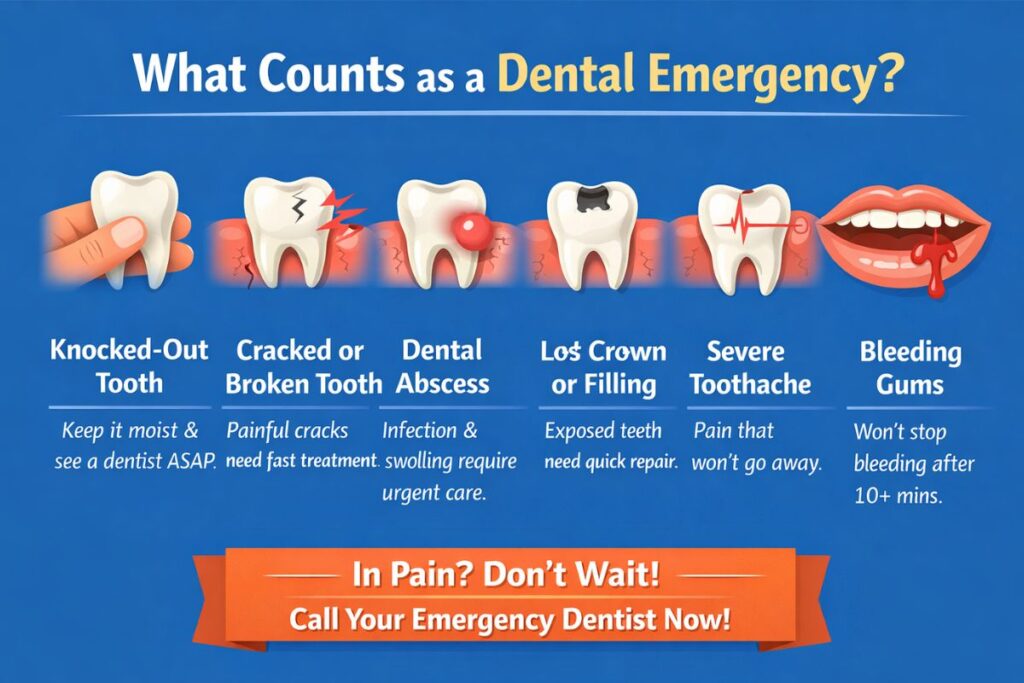
One of the most common reasons people delay dental care is uncertainty about whether their situation warrants urgent attention. The bar is lower than most people think. If the pain is affecting your daily life, if you notice swelling, or if something is visibly wrong with a tooth, those are all legitimate reasons to call.
The following situations should always be treated promptly:
- A knocked-out permanent tooth (handle only by the crown, keep it moist in milk or saliva, and get to a dentist immediately)
- A cracked or fractured tooth, especially if it’s causing sharp pain when biting
- A dental abscess or visible gum swelling, which may indicate a spreading infection
- A lost crown or filling that has left the underlying tooth exposed
- Severe, persistent toothache that doesn’t ease with over-the-counter pain relief
- Soft tissue injuries inside the mouth that won’t stop bleeding after 10 to 15 minutes of applied pressure
Some of these, like a lost filling, feel minor. But leaving a tooth exposed to bacteria, temperature changes, and bite pressure accelerates decay and can turn what would have been a simple repair into a root canal or an extraction. The situation doesn’t stay still while you wait.
How Emergency Care Protects Your Teeth Long-Term
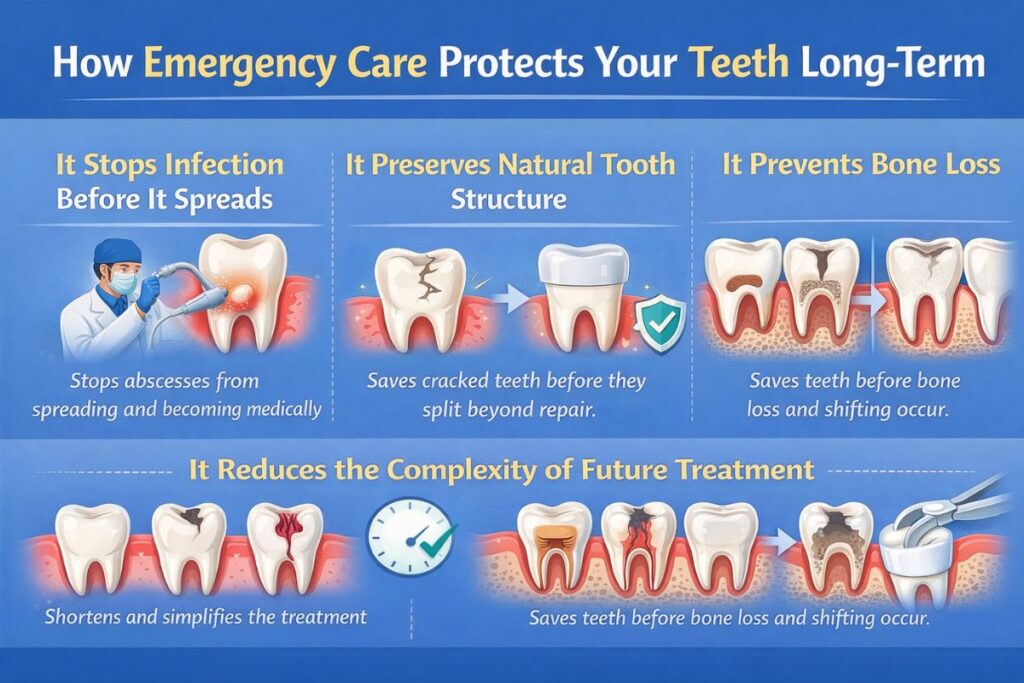
It Stops Infection Before It Spreads
A dental abscess doesn’t stay contained to one tooth. Left untreated, the bacterial infection can spread to surrounding bone and gum tissue, and in serious cases, move beyond the jaw entirely. Infections that reach the neck or airway can become medically dangerous quickly. Treating an abscess with drainage, antibiotics, and follow-up care stops this progression before it has a chance to escalate.
It Preserves Natural Tooth Structure
Natural teeth are worth fighting for. A cracked tooth that’s bonded or crowned quickly retains most of its original structure. The same tooth, left unprotected, continues to fracture under normal bite pressure. What starts as a manageable crack can split to the root over time, at which point extraction becomes the only option. Acting early keeps more of what’s already there.
It Prevents Bone Loss
Tooth loss triggers a process called alveolar bone resorption, where the jawbone in the area of the missing tooth gradually shrinks from lack of stimulation. This can alter your facial structure, affect adjacent teeth, and complicate future restorative options. Saving a tooth through timely emergency care avoids this cascade entirely. If extraction does become necessary, prompt treatment at least shortens the window in which bone loss begins.
It Reduces the Complexity of Future Treatment
Dental treatment generally becomes more involved the longer a problem is left unaddressed. A cavity caught and filled early is a routine procedure. That same cavity, left to progress into the pulp, becomes a root canal. A root canal left untreated leads to extraction. Emergency care interrupts this progression at whatever stage you’re in, which almost always means less treatment overall.
What to Do Before You Get to the Dentist
A few simple steps in the first minutes after a dental emergency can make a real difference in outcomes. Keep these in mind:
- For a knocked-out tooth: Pick it up by the crown, never the root. Rinse it gently without scrubbing. If possible, place it back in the socket. If not, store it in a glass of milk or between your cheek and gum to keep the root cells alive.
- For a cracked tooth: Rinse your mouth with warm water, apply a cold compress to reduce swelling, and avoid putting pressure on that side of your mouth.
- For an abscess: Do not try to pop or drain it yourself. Rinse with warm salt water to reduce bacteria in the area and call your dentist immediately.
- For a lost crown or filling: Dental cement from a pharmacy can temporarily protect the exposed tooth, but this is a bridge, not a fix. See your dentist as soon as possible.
- For any dental emergency: Call your dentist before heading in so the team can prepare and ensure you’re seen quickly when you arrive.
Don’t Wait on Dental Pain
Dental emergencies rarely resolve on their own. What feels manageable today can become a much bigger problem by the end of the week. If you’re dealing with pain, swelling, a broken tooth, or anything that doesn’t seem right, that’s your cue to call.
Contact First-In-Smiles Dentistry today for same-day emergency care in Matthews. Our team will assess your situation, address your pain, and put together a clear plan for protecting your smile going forward. The sooner you come in, the more options you have.
FAQs
Can a cracked tooth heal on its own?
No. Unlike bone, tooth enamel does not regenerate or repair itself. A cracked tooth will not close or seal on its own over time. Depending on the depth and location of the crack, treatment may involve bonding, a dental crown, or in more severe cases, a root canal if the pulp has been reached. Early treatment prevents the crack from deepening and spreading under normal bite pressure.
Is a toothache always a dental emergency?
Not every toothache requires same-day care, but persistent, severe, or worsening pain usually does. If your tooth is throbbing continuously, if the pain wakes you at night, or if you notice swelling or a fever alongside the toothache, treat it as urgent. These are signs of infection or significant nerve involvement that won’t improve without intervention.
What happens if a dental abscess is left untreated?
An untreated abscess can spread the bacterial infection from the original tooth into surrounding tissue, the jawbone, and in serious cases, the neck or chest. Dental abscesses have caused life-threatening complications when ignored for extended periods. Beyond the health risk, the longer the infection is active, the more bone and tissue damage occurs, which complicates treatment once you do seek care.
Will I need a root canal after a dental emergency?
Not necessarily. Root canal therapy is needed when the pulp of a tooth has become infected or severely compromised. Many dental emergencies, especially those addressed quickly, can be resolved with less involved treatments such as bonding, a crown, or antibiotic therapy. The likelihood of needing a root canal increases the longer an issue is left without care.
Does dental insurance cover emergency dental visits?
Most dental insurance plans cover at least a portion of emergency dental visits, particularly for examinations and diagnostic imaging. The extent of coverage for specific treatments like extractions, root canals, or crowns depends on your individual plan. If you’re unsure about your coverage, the front desk at your dental office can typically verify your benefits before your appointment.